
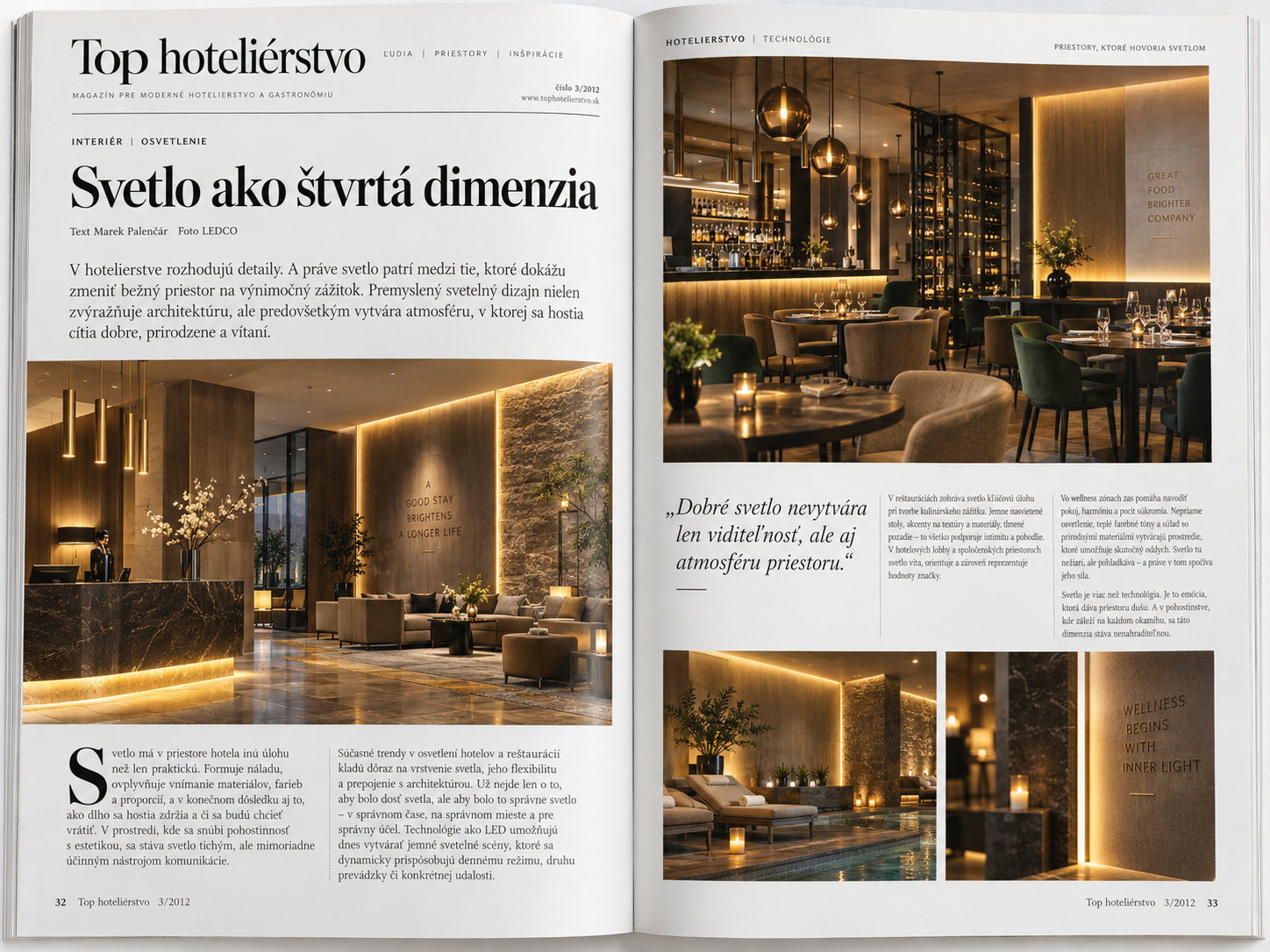
LEDCO in TOP HOTELIERSTVO 2012 – Light as the fourth dimension
Architecture defines a space. Light determines how we perceive it. As early as 2012, we wrote in the professional publication TOP HOTELIERSTVO about lighting design as the “fourth dimension of architecture” – a tool capable of changing atmosphere, orientation, visual comfort and the emotions people experience in a space.
The expert article “Light as the fourth dimension” was published in TOP HOTELIERSTVO 2012.
Across pages 42–43, it explored lighting design for hotels, restaurants and commercial spaces, but above all a principle that still forms the basis of our work today:
Meeting a standard is not enough. Quality lighting must work technically, support the architecture and create the right feeling in the space.
Light creates emotion
Light is one of the most powerful tools for influencing the atmosphere of a space.
A romantic dinner in a restaurant needs very different lighting conditions from a hotel reception, a workplace or a space requiring a high degree of visual precision.
There is therefore no single universal “correct light”.
The task of lighting design is to find the right combination of intensity, direction, contrast, light colour and luminaires according to what will happen in the space and how people should feel there.
This ability to work with light as an emotion is what separates lighting design from simply positioning luminaires.
A hotel or restaurant is not sold by interior design alone
In hotels, restaurants, showrooms and other commercial spaces, lighting has another important role.
It influences the customer’s first impression.
Visitors rarely judge materials, luminaires or architectural elements separately. They perceive the space as a whole.
Light helps determine:
- which elements they notice first,
- how large the space feels,
- whether materials feel rich or flat,
- whether they feel comfortable,
- where their attention is naturally directed,
- and what atmosphere they associate with the space.
That is why the original 2012 article already highlighted sales psychology and the importance of light in presenting spaces and products.
The principle remains just as relevant today.
Not everything needs to be lit equally
A technically simple solution can be based on uniform illumination across the entire area.
The result, however, is often a visually flat space with no hierarchy.
Professional lighting design works with differences.
Some areas can remain calmer while others are emphasised. Light can guide people through a space and draw attention to a reception desk, artwork, wall material, table, product or architectural detail.
This creates contrast and lighting hierarchy.
And hierarchy is what gives a space depth.
Visual comfort matters as much as the amount of light
More light does not automatically mean better lighting.
A design must consider not only the required illuminance but also:
- glare,
- contrast,
- the direction of incident light,
- the luminance of individual surfaces,
- reflections,
- colour rendering quality,
- correlated colour temperature,
- light distribution,
- the balance between direct and indirect lighting.
A poorly positioned luminaire can have sufficient output and still make a space uncomfortable.
This is why visual comfort is one of the fundamental parameters of good lighting design.
Lighting designer – technician and designer
The original article was already discussing the profession of the lighting designer in 2012.
The role sits at the intersection of several disciplines.
A lighting designer needs to understand technology, photometry and luminaire performance, while also understanding architecture, materials, perspective and human perception.
Lighting design is therefore more than a technical calculation.
It combines:
technology + architecture + physics + design + experience.
A calculation can confirm that a project meets the required parameters.
Only a well-developed lighting concept determines how the finished space will actually feel.
Light as the fourth dimension of architecture
A building does not change during the day.
After dark, however, its character can change completely.
Light can emphasise volume, facade texture, lines, materials or individual architectural elements. The same applies to interiors.
This is why the article compared light to the fourth dimension of architecture.
A space is not defined by geometry alone.
What people actually perceive of architecture is largely the result of the interaction between surfaces, shadows, contrast and light.
From conventional luminaires to intelligent control
Lighting technology has advanced significantly since 2012.
Today, a single project can combine professional LED luminaires, linear systems, accent lighting, decorative luminaires, sensors and digital control.
Systems such as DALI and Casambi make it possible to create lighting scenes and change the character of a space according to how it is being used.
In a hotel or restaurant, the same space may work differently:
- in the morning,
- during the day,
- in the evening,
- during a social event,
- during cleaning or service work.
Modern controls can make this flexibility much easier to manage.
One fundamental rule still applies:
intelligent control does not replace good lighting design – it only expands its possibilities.
We were writing about lighting design as early as 2012
Looking at the article today, its value lies in more than a historical mention of LEDCO in a professional publication.
It documents that more than a decade ago we were already addressing issues that remain at the heart of our work:
- visual comfort,
- lighting hierarchy,
- atmosphere,
- sales psychology,
- architecture,
- correct light direction,
- professional lighting design.
Technology, luminaires and control possibilities have changed considerably since then.
The principle of good lighting has not.
Light needs a purpose, a function and the right place.
Original article
Publication: TOP HOTELIERSTVO 2012
Article: Svetlo ako štvrtá dimenzia
Pages: 42–43
Text: Marek Palenčár
Photography: LEDCO
“View the original article Svetlo ako štvrtá dimenzia in TOP HOTELIERSTVO 2012.”
LEDCO – professional lighting from design to implementation
At LEDCO, we have long focused on professional lighting and lighting design for commercial, office, industrial, public and residential spaces.
Our designs consider not only the amount of light, but also its quality, optics, visual comfort, the architecture of the space and control options.
Because good lighting is not only what we see. It is also the way we experience a space.