
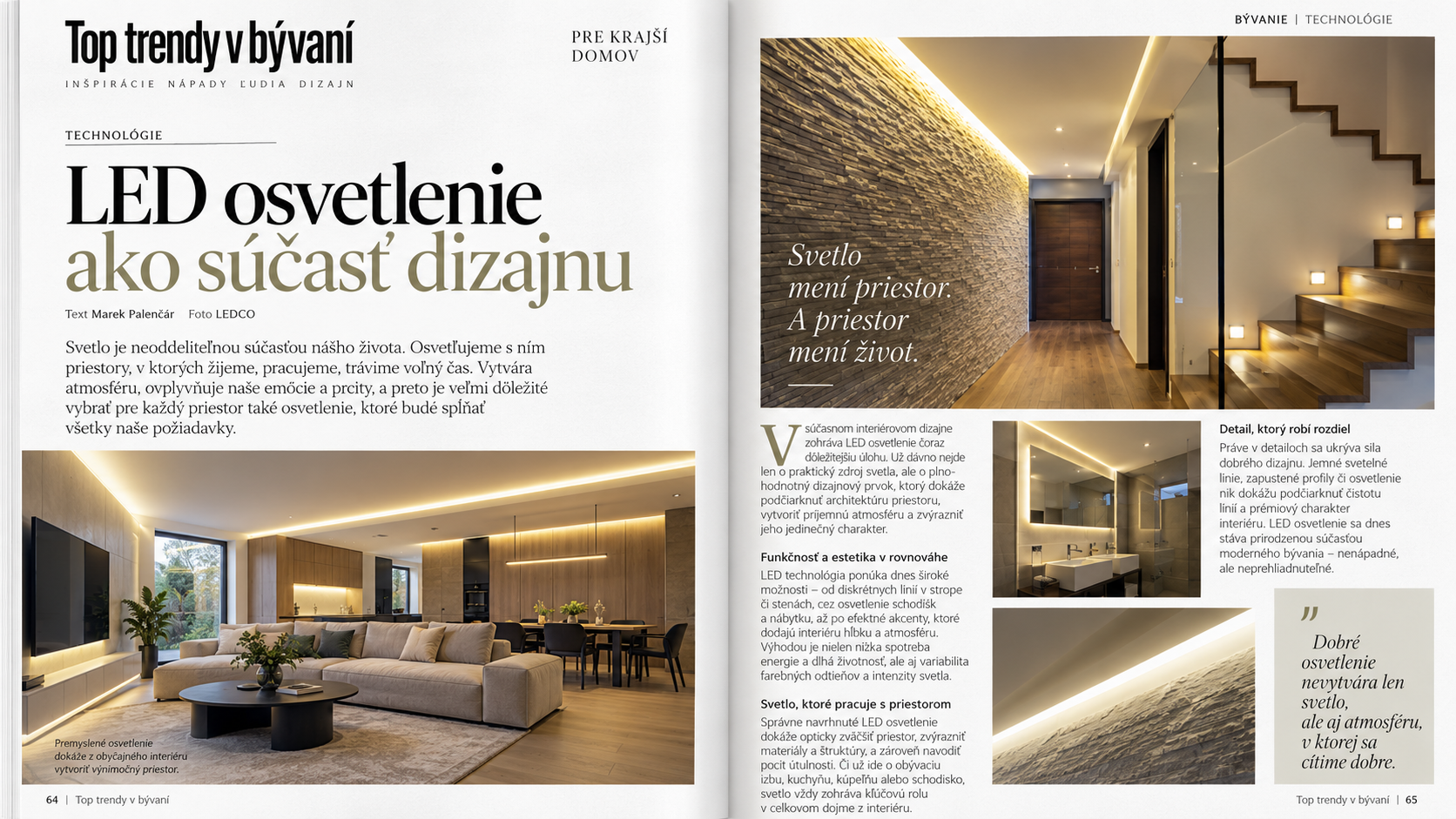
LEDCO in TOP TRENDY V BÝVANÍ 2012 – LED lighting as part of interior design
At LEDCO, we have never regarded light as merely a technical necessity. As early as 2012, we wrote in the professional magazine TOP TRENDY V BÝVANÍ about LED lighting as an integral part of architecture, interior design and the atmosphere of a space.
The expert article “LED lighting as part of design” was published in TOP TRENDY V BÝVANÍ 2012 on pages 114–115.
The article was written by Marek Palenčár, with photographs supplied by LEDCO s.r.o.
Looking back, it is interesting not only to see how far LED technology has developed, but also how many fundamental principles of good lighting design have remained unchanged.
Lighting is more than a luminaire
One of the article’s central ideas was a move away from the traditional approach of lighting a room with a single central luminaire.
Good lighting is created by combining several lighting elements, each with a different role.
General lighting provides the required light level. Accent lighting highlights selected features, materials or architecture. Indirect and linear lighting can create atmosphere and completely change how we perceive a space.
The result should therefore not be merely a collection of selected luminaires, but a carefully considered lighting concept.
This approach remains the foundation of professional lighting design.
Light as part of architecture and interior design
Well-designed light can emphasise material textures, support the proportions of an interior, visually alter a space and direct attention to its most important features.
This is why we were already describing light as a tool of architecture and design in 2012.
It matters:
- where the light comes from,
- the angle at which it falls,
- which surfaces it highlights,
- how intense it is,
- the character of its distribution,
- the colour and quality of light we use,
- and how the individual layers of light work together.
Good lighting should not compete with architecture. It should support it.
Lighting systems instead of a single light point
The TOP TRENDY V BÝVANÍ article highlighted the trend of combining different types of luminaires into one functional whole.
This principle has since become a standard of quality lighting design.
Today, a single space may combine:
- main functional lighting,
- spot and directional lighting,
- pendant luminaires,
- linear LED lighting,
- indirect lighting,
- decorative luminaires,
- lighting integrated into furniture and architectural details.
Each layer can have a different purpose and intensity.
When combined correctly, they create a space that works technically while also feeling natural and comfortable.
LED technology opened up new design possibilities
In 2012, LED technology was developing at an exceptionally rapid pace.
One of its major advantages was the small size of the light source. Designers and manufacturers were no longer constrained by the dimensions of traditional bulbs, fluorescent lamps or discharge lamps when creating luminaires.
This created room for minimalist luminaires, subtle lines of light, indirect lighting and the integration of light directly into architecture.
Many solutions that were new or progressive at the time are now a natural part of modern interiors.
A good example is linear LED lighting.
LED strips and profiles now allow continuous lines of light to be created in ceilings, walls, furniture, staircases and architectural details. The light source itself can be practically invisible, leaving only its effect to be perceived.
LED quality already mattered in 2012
The article also highlighted another subject that remains just as relevant today.
Not every product labelled LED represents high-quality professional lighting.
As the technology became more widely available, the market also filled with products of very different quality. This is why we were already emphasising the importance of expert selection.
For professional lighting, comparing only price or wattage is not enough.
The result is influenced by a whole set of properties:
- luminous flux,
- luminous efficacy,
- optics and light distribution,
- correlated colour temperature,
- colour rendering quality,
- glare,
- colour consistency,
- LED chip quality,
- power supply quality,
- thermal management,
- service life,
- dimming and control options.
It is equally important to know where and for what purpose the luminaire will be used.
A technical parameter that is an advantage in one project may not be the optimal solution in another.
Technology changes, the principles of good lighting remain
The capabilities of LED technology have advanced considerably since the article was published.
Today’s professional systems offer higher efficiency, more precise optics, better colour rendering, extensive dimming options and intelligent control.
A lighting project can now incorporate DALI, Casambi and other control technologies, presence sensors, automatic daylight regulation and individual lighting scenes.
The fundamental principle, however, has not changed.
The best results do not come from choosing the most powerful or most expensive luminaire. They come from understanding the space and combining light, technology and architecture correctly.
A long-standing focus on professional lighting
The TOP TRENDY V BÝVANÍ article is now also part of LEDCO’s history.
It documents a period when LED technology was only beginning its widespread adoption, while we were already working with its practical applications, lighting design and professional lighting planning.
Over time, we expanded this experience into comprehensive lighting projects, professional installations, lighting control, electrical installations and further solutions for commercial, industrial, public and residential spaces.
The technology has changed fundamentally over the years.
The need to understand light has not.
The combination of technical knowledge, practical project experience and the ability to see light as part of architecture is therefore an approach LEDCO has followed for many years.
Original article in TOP TRENDY V BÝVANÍ
Publication: TOP TRENDY V BÝVANÍ 2012
Article: LED osvetlenie ako súčasť dizajnu
Pages: 114–115
Text: Marek Palenčár
Photography: LEDCO
“View the original article LED osvetlenie ako súčasť dizajnu in TOP TRENDY V BÝVANÍ 2012.”
LEDCO – professional lighting from design to implementation
At LEDCO, we provide lighting design, professional lighting supply, intelligent control and implementation of lighting and electrical systems.
We do not design from a luminaire catalogue alone. We assess the space, its function, required lighting parameters, architecture and how it will be used.
Because good lighting does not begin with choosing a luminaire.
It begins with understanding what the light needs to achieve in that particular space.