
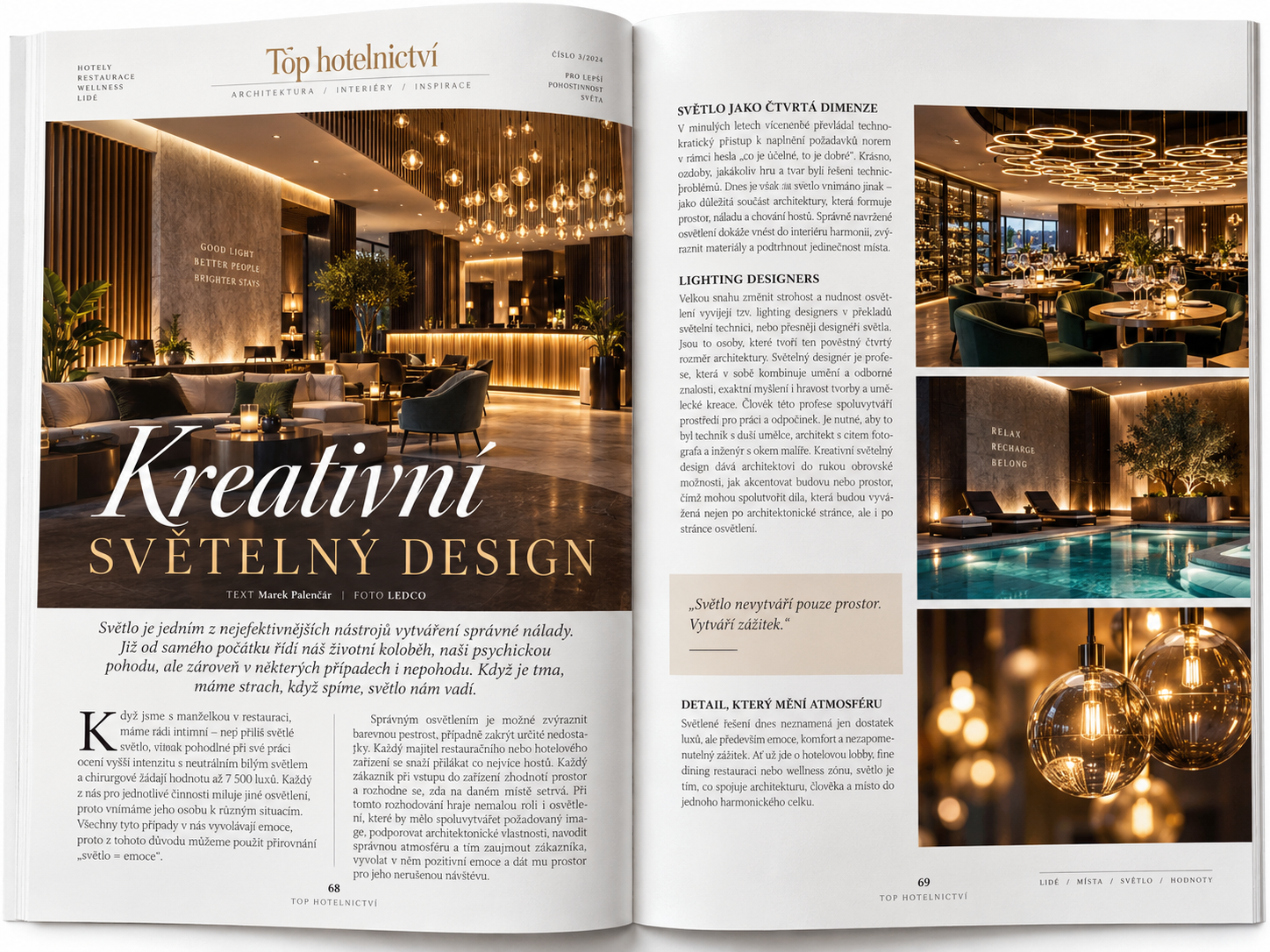
LEDCO in TOP HOTELNICTVÍ 2013 – Creative lighting design
Lighting can meet every technical requirement and still leave a space visually uninteresting. As early as 2013, in the professional publication TOP HOTELNICTVÍ, we highlighted the difference between light designed only around technical parameters and creative lighting design that actively works with architecture, atmosphere and human emotion.
The expert article “Kreativní světelný design” was published in the Czech publication TOP HOTELNICTVÍ 2013.
The article was written by Marek Palenčár, with photographs supplied by LEDCO.
More than a decade later, its central question is still relevant:
Is it enough for a space to have the required number of lux, or should quality lighting deliver something more?
At LEDCO, we already believed in the second approach.
Technically correct does not automatically mean good
Every lighting project must respect standards, required illuminance levels, safety and the function of the space.
That is the essential foundation.
Meeting technical parameters alone, however, does not guarantee a good result.
A space can be evenly illuminated and achieve the required illuminance while still feeling flat, lacking contrast, depth or atmosphere.
The difference appears when we start asking:
- what should people notice first,
- which architectural elements should be emphasised,
- where a calmer lighting level is needed,
- what kind of contrast we want to create,
- how light falls on materials and surfaces,
- and what emotion the finished space should evoke.
This is where technical illumination becomes lighting design.
Light creates hierarchy within a space
One important subject in the original article was the use of contrast and hierarchy.
Not every part of a space needs to be lit equally.
Quite the opposite.
By directing light deliberately, we can naturally divide a space into zones and determine where people look first.
In a hotel, it may be the reception desk.
In a restaurant, a table or architectural detail.
In a shop, a displayed product.
In a gallery, a work of art.
Outside, it may be the facade, entrance or a distinctive part of the building.
Good lighting design therefore works not only with the amount of light but also with its direction, contrast and the relationship between individual lighting levels.
Light = emotion
The original article also used a simple idea:
light creates emotion.
Warm, subdued light over dinner creates a completely different feeling from intense task lighting.
We also instinctively notice uncomfortable glare, a space that is too dark or an unsuitable light colour.
People do not need to be able to identify the technical reason.
They simply feel whether a space is comfortable or uncomfortable.
This is one reason why professional lighting design cannot be based solely on a table of technical parameters.
Light has physically measurable properties, but its final effect is always perceived by people.
Who is a lighting designer?
A substantial part of the 2013 article was devoted to the profession of the lighting designer.
It is a profession at the boundary between engineering and creative work.
A lighting designer needs to understand:
- photometry,
- the properties of light sources and luminaires,
- optics,
- standards,
- control and regulation,
- architecture,
- materials and surfaces,
- colour,
- composition,
- and human perception.
In the original article, we compared this combination of technical and creative thinking to a person who has to combine several professions at once.
That interdisciplinary nature is precisely what makes lighting design demanding.
It is not enough to know how much light a luminaire produces. You need to know what to do with that light in the space.
Architecture and light need to be developed together
The best result comes when lighting is addressed during the design of the architecture or interior.
If luminaires are only considered after the project is complete, the possibilities for lighting design are often significantly limited.
The finished electrical positions, ceilings, furniture, materials and construction details then have to be respected.
When the lighting designer is involved early, light can instead be integrated naturally into the architecture.
We can work with:
- linear lighting,
- recessed luminaires,
- luminous ceilings,
- indirect light,
- accent lighting,
- lighting integrated into furniture,
- architectural details,
- facade lighting.
The result no longer looks like electrical equipment added afterwards.
Light becomes part of the architecture.
Lighting design in hotels and restaurants
The original article appeared in a hospitality publication, so it naturally focused on hotels and restaurants as well.
Quality lighting is particularly important in these spaces.
Guests form an impression of the atmosphere very quickly after entering.
Lighting influences:
- the perceived quality of the interior,
- the colours of the materials used,
- the sense of comfort,
- orientation,
- intimacy,
- food presentation,
- architectural details,
- and the overall character of the brand.
Expensive materials or a high-quality interior can be visually undermined by poor lighting.
Conversely, a thoughtful lighting design can enhance even relatively simple architecture.
Light as part of sales psychology
In 2013, the article also highlighted the importance of light in sales.
The principle applies not only to hotels and hospitality but also to retail and showrooms.
Customers need to see products in the right light.
That includes their:
- colour,
- surface,
- texture,
- gloss,
- contrast with the surroundings,
- and visual emphasis.
Well-designed accent lighting can naturally guide customer attention without making the space feel aggressive or overlit.
This is why lighting is part of the overall customer experience design.
Visual comfort comes before effect
Creative lighting design cannot ignore user comfort.
A dramatic effect does not automatically mean a good design.
Every project therefore also needs to check:
- glare,
- reflections,
- luminaire brightness,
- lighting contrasts,
- the position of light sources within the field of view,
- the suitability of the light for the specific activity.
The aim is not to create an effect at any cost.
The aim is to combine visual experience with functionality and comfort.
From lighting design to intelligent lighting
The possibilities available to lighting designers have expanded significantly since 2013.
Today’s LED technologies offer more precise optics, higher efficiency, better colour rendering and much broader control possibilities.
Systems such as DALI and Casambi make it possible to change lighting intensity, create scenes and adapt a single space to different situations.
A restaurant can use one scene for breakfast and another in the evening.
A hotel lobby can respond to the time of day.
A commercial space can regulate artificial lighting according to the available daylight.
The technology has advanced considerably.
The principle remains the same:
lighting control is valuable only when it controls a well-designed lighting system.
LEDCO and lighting design as early as 2013
For LEDCO, this article is an interesting part of our history.
It documents that our work in professional lighting was never limited to selling luminaires. More than a decade ago, we were already publicly communicating the importance of:
- professional lighting design,
- creative lighting design,
- visual comfort,
- architecture,
- lighting hierarchy,
- emotion,
- and the work of a professional lighting designer.
The technical possibilities have changed fundamentally since then.
The need to connect technology with architecture and human perception remains exactly the same.
This is still the approach we use in LEDCO lighting projects today.
Original article
Publication: TOP HOTELNICTVÍ 2013
Article: Kreativní světelný design
Text: Marek Palenčár
Photography: LEDCO
“View the original article Kreativní světelný design in TOP HOTELNICTVÍ 2013.”
LEDCO – professional lighting design
At LEDCO, we provide lighting design, professional lighting, intelligent control and implementation of lighting and electrical systems.
When designing a project, we are not simply looking for a luminaire that delivers enough lux.
We are looking for the right way for light to work in the specific space.